Target role
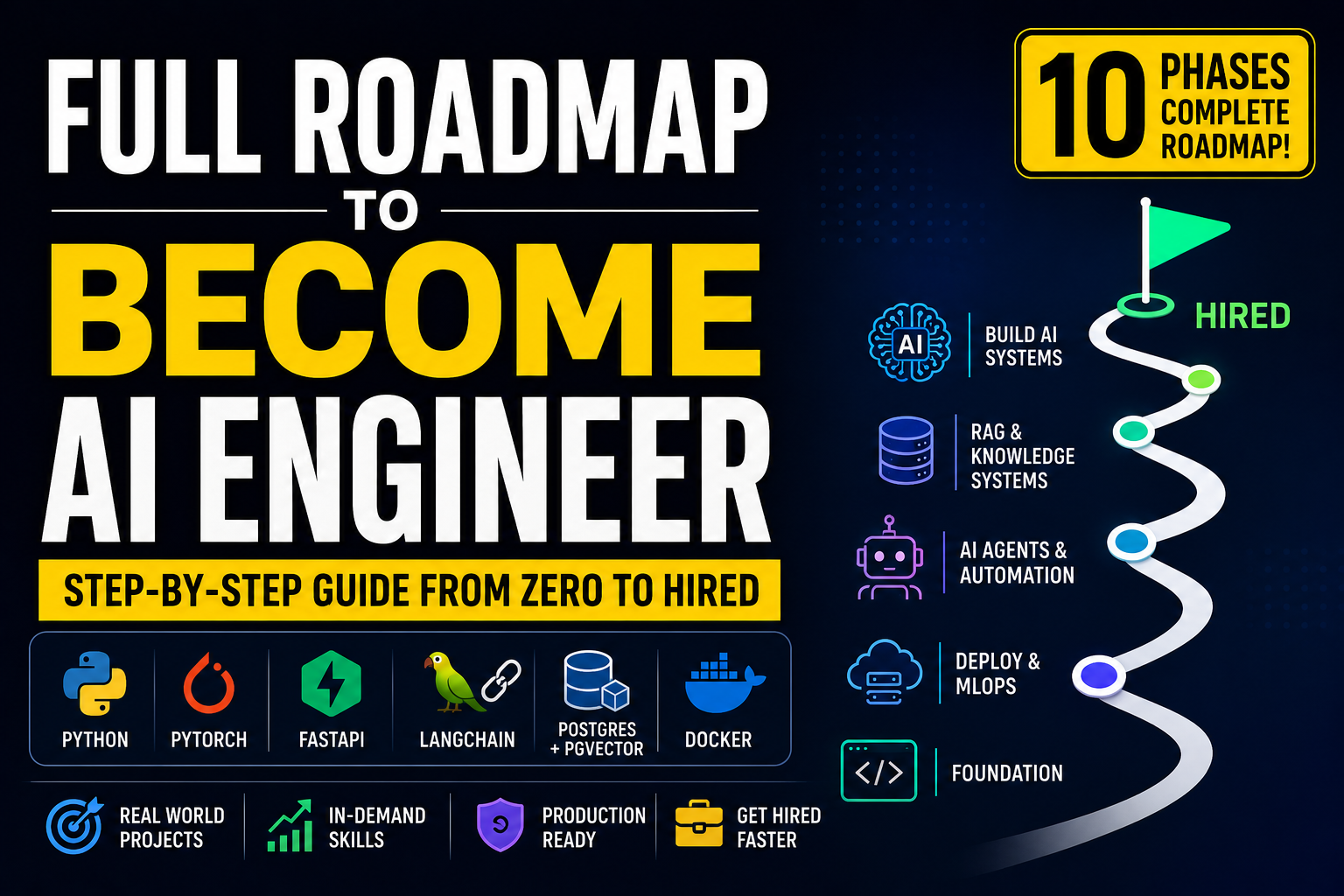
Not just “prompt engineer”. Real AI Engineer means you can build, deploy, monitor, and improve AI systems: ML models, LLM apps, RAG, agents, evaluation, APIs, and production infrastructure.
Your advantage
Because you already know fullstack, backend, IoT, NestJS, Next.js, Docker, and APIs, you should aim for AI Product Engineer / LLM Engineer, not pure research scientist first.
Best target:
Backend/Fullstack Engineer → AI Engineer → AI Systems Engineer / LLM Engineer
Phase 1 — Python + Data Foundation
Learn:
- Python deeply
- NumPy
- Pandas
- Matplotlib
- Jupyter
- SQL for analytics
- Data cleaning
- APIs with FastAPI
Build:
- CSV analyzer
- Sales prediction dashboard
- Data cleaning pipeline
- FastAPI AI microservice
You must be comfortable reading messy data. Bad data is normal in real AI systems.
Phase 2 — Math for AI
Do not over-study math for 1 year. Learn only what you need.
Learn:
- Linear algebra: vectors, matrices, dot product
- Calculus basics: derivative, gradient
- Probability: distribution, Bayes, expectation
- Statistics: mean, variance, standard deviation, correlation
- Optimization: gradient descent
Goal: understand why model training works, not become mathematician.
Phase 3 — Machine Learning
Learn:
- Supervised learning
- Unsupervised learning
- Classification
- Regression
- Clustering
- Feature engineering
- Train/test split
- Overfitting
- Cross-validation
- Metrics: accuracy, precision, recall, F1, ROC-AUC
Tools:
- scikit-learn
- XGBoost / LightGBM
- MLflow basic
Build:
- Fraud detection
- Customer churn prediction
- Product recommendation
- Transaction anomaly detection
- Loan/payment risk scoring
This phase makes you useful for business AI.
Phase 4 — Deep Learning
Learn:
- Neural networks
- Backpropagation
- CNN
- RNN/LSTM basics
- Transformers
- Embeddings
- Fine-tuning
- Transfer learning
Use PyTorch. It is one of the main deep learning frameworks, with tensor computation, GPU acceleration, and neural network tooling. 
Build:
- Image classifier
- OCR/document classifier
- Time-series prediction
- Simple transformer text classifier
Do not waste too much time building neural nets from scratch. Understand it, then use frameworks.
Phase 5 — LLM Engineering
This is the highest ROI for you.
Learn:
- OpenAI / Gemini / Claude APIs
- Hugging Face Transformers
- Tokenization
- Embeddings
- Prompt design
- Function calling / tool calling
- Structured output
- Streaming response
- Context window management
- Model selection
- Cost optimization
Hugging Face Transformers gives access to a large ecosystem of pretrained model checkpoints and tools for using transformer models. 
Build:
- AI customer support bot
- AI document summarizer
- AI task generator
- AI code reviewer
- AI PM assistant
- AI chatbot with role/permission control
Phase 6 — RAG
RAG is mandatory for real company AI.
Learn:
- Document ingestion
- Chunking
- Embeddings
- Vector database
- Hybrid search
- Reranking
- Citation
- Context compression
- Query rewriting
- Evaluation
Tools:
- PostgreSQL + pgvector
- Qdrant
- Weaviate
- Pinecone
- Elasticsearch
- LangChain / LlamaIndex
LangChain documents common RAG patterns, including simple two-step RAG chains and RAG agents that can decide when to retrieve context. 
Build:
- Company document Q&A
- API documentation assistant
- Legal/contract search bot
- Internal PM agent using GitHub + Plane + Slack
- Technical support assistant for IoT devices
Phase 7 — AI Agent Engineering
Learn:
- Tool calling
- Planning
- Agent memory
- Multi-step workflows
- Human approval
- Retry logic
- Guardrails
- Permissions
- Audit logs
- Background jobs
- Queue workers
Build:
- PM Agent
- GitHub PR reviewer
- Slack daily startup reporter
- Requirement updater
- Bug ticket creator
- Release branch reviewer
Bad agent design: “AI can do everything.”
Good agent design: small deterministic workflow + AI only where judgment is useful.
Phase 8 — MLOps / Production AI
Learn:
- Docker
- GPU basics
- Model serving
- FastAPI
- Queue workers
- Redis
- PostgreSQL
- Object storage
- MLflow
- CI/CD
- Monitoring
- Model versioning
- Prompt versioning
- Evaluation pipeline
Important production topics:
- latency
- cost per request
- fallback model
- retries
- rate limits
- logging
- PII protection
- hallucination detection
- permission filtering
- observability
Build:
- AI API gateway
- Prompt/version management system
- RAG evaluation dashboard
- AI usage billing system
- Model monitoring dashboard
Phase 9 — Local AI / Edge AI
Because you do IoT, this is valuable.
Learn:
- Ollama
- LM Studio
- llama.cpp
- GGUF models
- quantization
- ONNX
- TensorRT basic
- edge inference
- offline AI
Build:
- Local AI assistant for factory/lab
- Offline troubleshooting chatbot
- IoT device log analyzer
- Vision inspection system
- Voice command system for machine
This can become your unique advantage: AI + IoT + backend + dashboard.
Phase 10 — Portfolio Projects
Build 5 serious projects.
Project 1: AI Document Assistant
Stack:
- Next.js
- NestJS/FastAPI
- PostgreSQL + pgvector
- OpenAI/Hugging Face
- Docker
Features:
- upload PDF
- chunk document
- vector search
- chat with citations
- role-based permission
- history
- feedback button
Project 2: AI PM Agent
Features:
- connect GitHub
- read PRs
- read Plane tasks
- summarize progress
- detect blockers
- generate Slack update
- create bug ticket after approval
This matches your real work. Strong portfolio.
Project 3: AI Code Reviewer
Features:
- review PR diff
- check requirement mismatch
- detect risky code
- comment suggestion
- generate test checklist
- severity scoring
Project 4: IoT Log AI Assistant
Features:
- ingest MQTT logs
- detect abnormal device behavior
- explain issue
- suggest fix
- create maintenance ticket
This is very strong for your background.
Project 5: AI Support Bot for SaaS
Features:
- RAG from docs
- account-aware answer
- escalation to human
- feedback loop
- admin analytics
12-Month Roadmap
Month 1
Python, NumPy, Pandas, SQL, FastAPI.
Output: data API + dashboard.
Month 2
Machine learning with scikit-learn.
Output: fraud/churn/risk prediction model.
Month 3
PyTorch deep learning.
Output: image classifier + text classifier.
Month 4
LLM API engineering.
Output: AI assistant with tool calling and structured output.
Month 5
Embeddings + RAG.
Output: document Q&A with citations.
Month 6
Advanced RAG.
Output: hybrid search, reranking, evaluation.
Month 7
AI agents.
Output: GitHub/Plane/Slack PM agent.
Month 8
Production AI backend.
Output: Dockerized AI service with logs, retries, queue, monitoring.
Month 9
Local AI.
Output: Ollama/LM Studio local assistant.
Month 10
Fine-tuning basics.
Output: fine-tuned classifier or instruction-tuned small model.
Month 11
AI security and evaluation.
Output: eval dashboard, hallucination tests, permission checks.
Month 12
Portfolio + job/business positioning.
Output: public demos, GitHub repos, case studies.
Weekly Study Schedule
Monday
Theory: ML / DL / LLM concept.
Tuesday
Code implementation.
Wednesday
Build feature into project.
Thursday
Debug, benchmark, improve.
Friday
Deploy and document.
Saturday
Build portfolio or real company use case.
Sunday
Review and write notes.
Minimum: 10–12 hours/week.
Good speed: 15–20 hours/week.
Best Stack for You
Use this:
- Python
- FastAPI
- PyTorch
- scikit-learn
- Hugging Face
- LangChain or LlamaIndex
- PostgreSQL + pgvector
- Redis
- Docker
- Next.js
- NestJS for business API
- FastAPI for AI service
- Ollama/LM Studio for local model
Do not force everything into NestJS. For AI, Python ecosystem is stronger.
What Not to Do
Avoid:
- studying math forever
- only watching courses
- only using ChatGPT prompts
- building toy chatbots only
- ignoring evaluation
- ignoring cost
- ignoring latency
- ignoring permissions/security
That is junior behavior.
Final Target Skillset
You should be able to build:
- AI chatbot
- RAG system
- AI agent
- ML prediction model
- AI backend API
- model evaluation pipeline
- local AI deployment
- AI dashboard
- AI automation for business workflows
Your strongest direction:
AI Engineer specialized in business automation, internal agents, RAG, and IoT/log intelligence.